David Weinberger’s Small Pieces Loosely Joined on the web and really enjoying it. I'm coming to appreciate just how our world (and learning in that world) is being changed by the influence of the internet--or was it always thus and the internet has just cranked it up significantly?
Wednesday, September 27, 2006
Reading online
I may be the last in the circle of my "blogosphere friends" to do so, but I'm now reading

Tuesday, September 26, 2006
Nancey Murphy
I have a great appreciation for Nancey Murphy's work on science & theology, and was pleased to find this collection of essays and links to interviews. Unfortunately, I'm just an interested layperson when it comes to the natural sciences, and still feel very much like a neophyte in theology, so I'm not going to try to attend the STARS conference in Mexico where she will be one of the presenters.
theological education
Keith Johnson at Generous Orthodoxy ThinkTank links to Gordon Graham’s convocation speech at Princeton Seminary last Tuesday, a very interesting exploration of theological education, especially for me since I'm finally getting around to reading David Kelsey's work on Athens/Berlin. Graham situates the heart of theological education in discipleship.
At the same blog, there's an entry by KevinHector entitled Five Theological Trends to Watch, of which the first is
- The resurgence of the analogia entis. The analogia entis or “analogy of being” has started getting a lot of attention, mainly from theologians who are interested in recovering a Catholic/Orthodox way of seeing the world (read: RO and its sympathizers). This trend corresponds with a not-to-be-missed AAR session: David Bentley Hart and George Hunsinger are scheduled to talk about this issue at the Barth Society meeting.
Now coming to you from Belfast
Make that Lambeg, actually, once a village but now part of the growing, vibrant city of Lisburn. We've been here a month and are getting settled into our very nice home and community. (Our broadband was hooked up only a week ago, and that's the excuse for not blogging that I'm sticking with!) It has been quite an experience finding our way through the process of getting established in another country. I honestly don't know how people manage a move to a country where the people speak another language. Of course, we've had to try to attune our ears to a version of English that isn't familiar, and those who speak Norniron are having to do the same with our Canadian accent. I actually heard someone use the expression "'Bout ye?" (like our "How are you doing?") today, something I'd been told to listen for. I've started another blog to record our settling-in adventures, so more of that there.
I'm a card-carrying Queen's student now, and the preliminary work I've been doing on my project has given me a good head start. I'm pleased that the main library has a good collection of Lonergan and Torrance is well represented at Union Theological College, and I received really good news about the education (social constructivism) aspect of my study (which I'll share later).
I'm a card-carrying Queen's student now, and the preliminary work I've been doing on my project has given me a good head start. I'm pleased that the main library has a good collection of Lonergan and Torrance is well represented at Union Theological College, and I received really good news about the education (social constructivism) aspect of my study (which I'll share later).
Tuesday, June 27, 2006
objective, subjective, and Lonergan
Man, I wish I were farther along in understanding Lonergan so that I could add his perspective to this great conversation going on between George Siemens and Stephen Downes. As I see it, Lonergan finds a new path (in reaction to a naive realism that says things are simply what they appear to be and avoiding the skepticism/solipsism of a radical intellectualism) by saying that objectivity grows out of one's faithful experiencing, understanding, judging, and choosing.
Saturday, June 17, 2006
Cycling in May
I had great plans for a big trip east, but a flat tire at Drinkwater and the change in wind direction while I got it fixed squashed that. I did manage to get in 400 km during the month, but all in short trips to Moose Jaw, Mortlach, and Buffalo Pound. One 40 km MJ round trip took me 1 hour 25 minutes, my best time so far.
conversion
This is really preliminary and sketchy, but I was thinking this morning about how Don Ihde says in _Experimental Phenomenology_ that, once we've noticed something about an object (as when, in a "gestalt change" we see from a new perspective what are popularly thought of as optical illusions), we can never see it simply in "the old way" again. Where Kuhn talks about a radical paradigm shift, Lakatos says that kind of change happens more slowly as we take in the new information and add it to what we thought before and sometimes, over time, replace old with new. That would be true of the 3-dimensional sketches--as Ihde says, with attention to our own thought processes ("meta-cognition") and with practice, we can see both and even switch between perspectives (so it's almost like watching the object move). I think that's what Lonergan means when he talks about sublation--building upon, sometimes to the point of overturning/replacing, former beliefs.
Monday, May 15, 2006
online learning
This from Dave Warlick, quoting Susan Patrick at the ncdla:
- Online expands options (high schools offer online course because otherwise they would not be available)
- Online learning is growing rapidly (30%/year)
- Online learning is effective (research shows that it is equal to or better than face-to-face)
- Online learning improves teaching
You take a teacher who’s been teaching for a few years, if they go through an online learning to teach online, they become a better teacher.
Patrick just said something that I think is very important. Please typically write more in an online learning environment than in face-to-face. This is important, because as people write about what they are learning, they tend to become more fluent in the issues of the topic.
The last 2 items are very interesting to me: teaching online makes one a better teacher, and writing (more) improves understanding.
Monday, May 08, 2006
Cycling in April
In April, I cycled to Besant and back on the 5th, 10th, and 28th; one way to Buffalo Pound with Darcy on the 14th; to Chaplin & back on the 15th (saw a huge antelope near Parkbeg!); one way to Regina on the 20th; to Moose Jaw and back on the 22nd and 24th (_really_ cold--my water bottle froze!) and then back to MJ for supper. Finally, I made a quick trip to Boharm on the 3oth, so my grand total for April is 500 km!
Monday, April 10, 2006
Objective/subjective
One of the important things in Lonergan is the way he, unquestionably, begins from the standpoint of the knower, but claims that, once we have come to reasonable certainty through rigorous thinking (including what is now being called metacognition), we have come to a defensible "objective" position. George Siemens, in a recent post, approaches this when he says, "The more precisely something can be conceived as subjective, the more it becomes objective." Further, in agreement with Dave Cormier's reference to "exploration," George's perspective resonates with what Lonergan calls "intentionality analysis": (in terms that I can understand) our built-in curiosity, the desire to know, that (I think) educators need to exploit. Later, Lonergan "cranked this up a notch," speaking instead of an intention to love--very interesting in light of the impetus toward community in those using social software.
Community
Denham Grey is working on Social Knowledge (wiki); Clarence Fisher, in a post on the educational potential of gaming, says about community:
"A community needs to be nurtured and grown. It cannot be created, it must create itself over time. It can be fed and helped along, but for a true community to emerge takes time, understanding, and knowledge of models of growth."
Wednesday, April 05, 2006
Trying and trying again
Some excellent advice from Karen Schwalm: "Teaching, with technology or without it, is a constant 'punch and feint,' trying one approach, measuring the response and impact, trying another approach, rethinking and redesigning the activity, getting feedback from students and really listening to it, trying again. Cool tools provide us more options, and we can create and re-create things quickly. First it's trial and error; then it's more focused classroom research. But it's still that upsy-down of the sine curve of teaching with technology."
Almost makes me want to try a hybrid class--f2f & online--again (someday).
Almost makes me want to try a hybrid class--f2f & online--again (someday).
Collegiality and collaboration
Excellent post by Christopher Sessums the other day--it resonates so much with what I want to promote in and among theological institutions.
Here is my paper given at the Abilene conference (in pbwiki).
Here is my paper given at the Abilene conference (in pbwiki).
Top 10 Clues
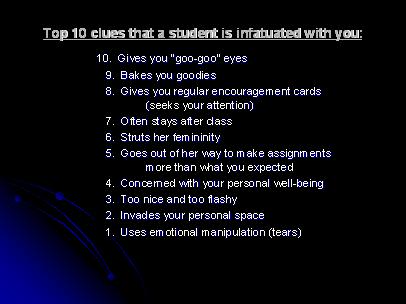
I'm on our Anti-Harassment Committee and am helping with a presentation to our faculty council this morning. As part of the discussion, Jacqueline is giving the "Top 10 clues that a student is infatuated with you."
Saturday, April 01, 2006
Cycling
A quick change of subject because I also want to use this blog space to remember my adventures in cycling. I was to Moose Jaw & back Saturday am (and then played an April fool's joke on both kids, saying my bike had been stolen) and then again on Sunday. So far this year, I have made trips from Maple Creek to the Cypress Hills park on January 8 and to Regina (one way) on January 26. I couldn't resist taking advantage of the unusually warm winter--which lasted until the first day of spring!
My so-sweet bike was a Christmas gift from my family. Aren't they great?
My so-sweet bike was a Christmas gift from my family. Aren't they great?
Keynotes
Hauerwas was his usual irrascible, boundary-pushing self. He set the tone with his "Theological Knowledge and the Knowledges of the University."
Billy Abraham, in his "Theology in the University in a Hobbesian World," helped me see where my overly optimistic views need a corrective. He notes that higher ed in North America operates on a 2-track system where scholars either dismiss revelation claims & study them phenomenologically or allow those claims but confine them to confessional contexts. His position is that we just need to accept this and "get on with it"; his advice is to do your best work and expect opposition and derision. On the other hand, he says theology needs to regain its proper place in the university; because "divine revleation is a threshold concept," we need to "pursue everything in the light of its resources--and we don't know all that that involves until we get there." He appealed to John Webster's appeal that we "develop a theological theology." His prescription for theologians if we are to avoid a pedestrian "nice" (my word) naivete: 1. boldness and a recovery of nerve, 2. depth and epistemological self-awareness, 3. imagination and creativity. He quoted Sarah Coakley on cultivating the intellectual and spiritual virtues that transcend polarization, from an article in Christian Higher Learning, a journal that I haven't been able to find. Apparently, it's a Routledge publication, but there's nothing about it on their site.
Ellen Charry spoke of scientia leading to sapientia through love & empathy. I wish she had had time for what she wanted to say about empathy (an interest of mine, as is obvious from earlier posts here), but her focus on the connection between pedagogy and formation (teachers as shepherds) was very helpful. She maintains that Foucault's "power" framework is apt only in the absence of such formation and a focus on the awareness of the knower.
Darryl Tippens (provost of Pepperdine) tied the conference themes together with an application to Church of Christ higher ed institutions, emphasizing that a "vibrant articulation of Christian vision" ("telling the best story") is the most impportant characteristic needed in a Christian university. He also recommends a focus on research scholarship, a community rich in memory, a radical hospitality, a heart-centered ethos (in the Biblical sense), a sacramental welcoming of mystery, wisdom and discernment that includes modelling & building community, practical service, and the spiritual development of faculty.
All in all, very good stuff, and a good push on my way to getting down to business on my research project!
Billy Abraham, in his "Theology in the University in a Hobbesian World," helped me see where my overly optimistic views need a corrective. He notes that higher ed in North America operates on a 2-track system where scholars either dismiss revelation claims & study them phenomenologically or allow those claims but confine them to confessional contexts. His position is that we just need to accept this and "get on with it"; his advice is to do your best work and expect opposition and derision. On the other hand, he says theology needs to regain its proper place in the university; because "divine revleation is a threshold concept," we need to "pursue everything in the light of its resources--and we don't know all that that involves until we get there." He appealed to John Webster's appeal that we "develop a theological theology." His prescription for theologians if we are to avoid a pedestrian "nice" (my word) naivete: 1. boldness and a recovery of nerve, 2. depth and epistemological self-awareness, 3. imagination and creativity. He quoted Sarah Coakley on cultivating the intellectual and spiritual virtues that transcend polarization, from an article in Christian Higher Learning, a journal that I haven't been able to find. Apparently, it's a Routledge publication, but there's nothing about it on their site.
Ellen Charry spoke of scientia leading to sapientia through love & empathy. I wish she had had time for what she wanted to say about empathy (an interest of mine, as is obvious from earlier posts here), but her focus on the connection between pedagogy and formation (teachers as shepherds) was very helpful. She maintains that Foucault's "power" framework is apt only in the absence of such formation and a focus on the awareness of the knower.
Darryl Tippens (provost of Pepperdine) tied the conference themes together with an application to Church of Christ higher ed institutions, emphasizing that a "vibrant articulation of Christian vision" ("telling the best story") is the most impportant characteristic needed in a Christian university. He also recommends a focus on research scholarship, a community rich in memory, a radical hospitality, a heart-centered ethos (in the Biblical sense), a sacramental welcoming of mystery, wisdom and discernment that includes modelling & building community, practical service, and the spiritual development of faculty.
All in all, very good stuff, and a good push on my way to getting down to business on my research project!
Theology in the Christian University
Back from the conference and recovering from the drive to Texas, I'm finally getting around to updating my blog. I really have to find some way to do this on a more regular basis. Anyway, the conference was good--a first for Abilene Christian University's grad school, but well handled by point man Fred Aquino. From all I heard there, he's doing a great job of promoting conversations across confessions. My paper featured a call for collaboration and community as a theological approach to academia, particularly through the affordances of social software. Interestingly, that theme was an undercurrent in several of the breakout sessions and keynotes. I picked up some important ideas to be added to my paper, and I will soon post a link to it on my pbwiki so I can get some more feedback. It's cool to see people across the institution doing theology in practical ways. (In that regard, I just listened to a podcast interview with Miroslav Volf re: his theological method, and I think I've found my home!)
I shared a presentation slot with the library folks, and it was very encouraging to see them applying the NT concept of hospitality (in the sense of welcoming strangers and sending on itinerant teachers) to their work with students. In practical terms, that's meant making the reference desk a welcoming, working-together kind of space instead of the imposing gatekeeper fortress it is in many libraries. Also, to encourage conversation in a "Learning Commons," they've added a coffee bar to the library. Imagine--no more "Shush" and "You can't bring that in here!"
Another presenter explored the theological issues around an exploration of the blues--the kind of music we'd never hear in church but has to be taken into account in an understanding of the human condition, including our own.
A shared presentation on the place of formation in the Christian university, from the perspective of Orthodoxy and through the lens of Clement of Alexandria's metaphor of "statues of the Lord," had some very rich content for me to process, particularly Clement's description of "educated Christians" (David Kneip's "translation" of C's "gnostics") as "forming and creating themselves" as "assistant sculptors." Sounds like constructivism to me. :)
More on the keynote speakers later: Stan Hauerwas, William Abraham, Ellen Charry, Darryl Tippens.
I shared a presentation slot with the library folks, and it was very encouraging to see them applying the NT concept of hospitality (in the sense of welcoming strangers and sending on itinerant teachers) to their work with students. In practical terms, that's meant making the reference desk a welcoming, working-together kind of space instead of the imposing gatekeeper fortress it is in many libraries. Also, to encourage conversation in a "Learning Commons," they've added a coffee bar to the library. Imagine--no more "Shush" and "You can't bring that in here!"
Another presenter explored the theological issues around an exploration of the blues--the kind of music we'd never hear in church but has to be taken into account in an understanding of the human condition, including our own.
A shared presentation on the place of formation in the Christian university, from the perspective of Orthodoxy and through the lens of Clement of Alexandria's metaphor of "statues of the Lord," had some very rich content for me to process, particularly Clement's description of "educated Christians" (David Kneip's "translation" of C's "gnostics") as "forming and creating themselves" as "assistant sculptors." Sounds like constructivism to me. :)
More on the keynote speakers later: Stan Hauerwas, William Abraham, Ellen Charry, Darryl Tippens.
Wednesday, March 22, 2006
Wow, what a drive!

We left our house just after 4 am Tuesday and got to North Platte just after 7 pm. When we crossed the border from North to South Dakota, we started seeing the snow along the road and it got worse and worse. The roads were fine, but the snow! Here's a pic from Valentine, Nebraska:
Along the way, there were hundreds of meadowlarks on the shoulders of the highway. I wonder if they got stranded on their way north. We also counted 41 "human snowbirds" in their RVs migrating back north, some of whom were from Saskatchewan. We're safely in Abilene tonight (got here at 6:45 pm), and looking forward to checking out the city before the conference starts tomorrow.
Friday, March 10, 2006
Ok, so this is harder than I thought
I'm finding it very difficult to find a time to post, so now my lack of will is evident to anyone who wants to check out the dates of previous postings.
Anyway . . . what George Siemens has been saying about connectivism was brought home to me this week when one day I got an email from George, who was so gracious as to read & comment on a paper I'm giving later this month, and another from Heidi Campbell, who was introduced to me by Dwight, a friend of mine who knew Heidi during her studies in Edinburgh. The same day, another friend who has been staying with us this week casually mentioned that she had met someone while in India a couple weeks ago, and we figured out that it was Dwight! George is from southern Manitoba, and friends who grew up in the same area visited with us a week ago. As a wonderful surprise, they sent me a beautiful pair of moccasins from northern Ontario, where they now live and we used to, and they arrived the same day as the emails I mentioned above. They at one time lived in northern Manitoba, in the town where Clarence Fisher is teaching, and he taught their kids (who are now both grown up--my, how time flies!).
In moves rather uncharacteristic of me, I had contacted both George and Heidi because they are working in a field that I'm fascinated by, and they have been so gracious. Many, many thanks to you, and to all whose blogs I have been learning so much from in the past while.
Anyway . . . what George Siemens has been saying about connectivism was brought home to me this week when one day I got an email from George, who was so gracious as to read & comment on a paper I'm giving later this month, and another from Heidi Campbell, who was introduced to me by Dwight, a friend of mine who knew Heidi during her studies in Edinburgh. The same day, another friend who has been staying with us this week casually mentioned that she had met someone while in India a couple weeks ago, and we figured out that it was Dwight! George is from southern Manitoba, and friends who grew up in the same area visited with us a week ago. As a wonderful surprise, they sent me a beautiful pair of moccasins from northern Ontario, where they now live and we used to, and they arrived the same day as the emails I mentioned above. They at one time lived in northern Manitoba, in the town where Clarence Fisher is teaching, and he taught their kids (who are now both grown up--my, how time flies!).
In moves rather uncharacteristic of me, I had contacted both George and Heidi because they are working in a field that I'm fascinated by, and they have been so gracious. Many, many thanks to you, and to all whose blogs I have been learning so much from in the past while.
Thursday, March 02, 2006
Time to start again
It's been a while since I posted anything here. I'm planning to pick it up again and post regularly, taking the all-important step from being a lurker/consumer of others' blogs to taking up writing for understanding. The biggest problem is that I have such a hard time writing and publishing anything that I haven't spent a lot of time thinking about and refining. Maybe this will be an opportunity to learn how to think on my feet--or with my fingers!
Subscribe to:
Posts (Atom)