Monday, May 15, 2006

online learning

This from Dave Warlick, quoting Susan Patrick at the ncdla:
  1. Online expands options (high schools offer online course because otherwise they would not be available)
  2. Online learning is growing rapidly (30%/year)
  3. Online learning is effective (research shows that it is equal to or better than face-to-face)
  4. Online learning improves teaching

You take a teacher who’s been teaching for a few years, if they go through an online learning to teach online, they become a better teacher.

Patrick just said something that I think is very important. Please typically write more in an online learning environment than in face-to-face. This is important, because as people write about what they are learning, they tend to become more fluent in the issues of the topic.

The last 2 items are very interesting to me: teaching online makes one a better teacher, and writing (more) improves understanding.

Monday, May 08, 2006

Cycling in April

In April, I cycled to Besant and back on the 5th, 10th, and 28th; one way to Buffalo Pound with Darcy on the 14th; to Chaplin & back on the 15th (saw a huge antelope near Parkbeg!); one way to Regina on the 20th; to Moose Jaw and back on the 22nd and 24th (_really_ cold--my water bottle froze!) and then back to MJ for supper. Finally, I made a quick trip to Boharm on the 3oth, so my grand total for April is 500 km!

Monday, April 10, 2006

Objective/subjective

One of the important things in Lonergan is the way he, unquestionably, begins from the standpoint of the knower, but claims that, once we have come to reasonable certainty through rigorous thinking (including what is now being called metacognition), we have come to a defensible "objective" position. George Siemens, in a recent post, approaches this when he says, "The more precisely something can be conceived as subjective, the more it becomes objective." Further, in agreement with Dave Cormier's reference to "exploration," George's perspective resonates with what Lonergan calls "intentionality analysis": (in terms that I can understand) our built-in curiosity, the desire to know, that (I think) educators need to exploit. Later, Lonergan "cranked this up a notch," speaking instead of an intention to love--very interesting in light of the impetus toward community in those using social software.

Community

Denham Grey is working on Social Knowledge (wiki); Clarence Fisher, in a post on the educational potential of gaming, says about community:

"A community needs to be nurtured and grown. It cannot be created, it must create itself over time. It can be fed and helped along, but for a true community to emerge takes time, understanding, and knowledge of models of growth."


Wednesday, April 05, 2006

Trying and trying again

Some excellent advice from Karen Schwalm: "Teaching, with technology or without it, is a constant 'punch and feint,' trying one approach, measuring the response and impact, trying another approach, rethinking and redesigning the activity, getting feedback from students and really listening to it, trying again. Cool tools provide us more options, and we can create and re-create things quickly. First it's trial and error; then it's more focused classroom research. But it's still that upsy-down of the sine curve of teaching with technology."
Almost makes me want to try a hybrid class--f2f & online--again (someday).

Collegiality and collaboration

Excellent post by Christopher Sessums the other day--it resonates so much with what I want to promote in and among theological institutions.
Here is my paper given at the Abilene conference (in pbwiki).

Top 10 Clues


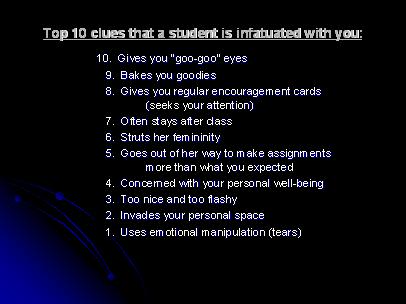
I'm on our Anti-Harassment Committee and am helping with a presentation to our faculty council this morning. As part of the discussion, Jacqueline is giving the "Top 10 clues that a student is infatuated with you."

Saturday, April 01, 2006

Cycling

A quick change of subject because I also want to use this blog space to remember my adventures in cycling. I was to Moose Jaw & back Saturday am (and then played an April fool's joke on both kids, saying my bike had been stolen) and then again on Sunday. So far this year, I have made trips from Maple Creek to the Cypress Hills park on January 8 and to Regina (one way) on January 26. I couldn't resist taking advantage of the unusually warm winter--which lasted until the first day of spring!
My so-sweet bike was a Christmas gift from my family. Aren't they great?

Keynotes

Hauerwas was his usual irrascible, boundary-pushing self. He set the tone with his "Theological Knowledge and the Knowledges of the University."
Billy Abraham, in his "Theology in the University in a Hobbesian World," helped me see where my overly optimistic views need a corrective. He notes that higher ed in North America operates on a 2-track system where scholars either dismiss revelation claims & study them phenomenologically or allow those claims but confine them to confessional contexts. His position is that we just need to accept this and "get on with it"; his advice is to do your best work and expect opposition and derision. On the other hand, he says theology needs to regain its proper place in the university; because "divine revleation is a threshold concept," we need to "pursue everything in the light of its resources--and we don't know all that that involves until we get there." He appealed to John Webster's appeal that we "develop a theological theology." His prescription for theologians if we are to avoid a pedestrian "nice" (my word) naivete: 1. boldness and a recovery of nerve, 2. depth and epistemological self-awareness, 3. imagination and creativity. He quoted Sarah Coakley on cultivating the intellectual and spiritual virtues that transcend polarization, from an article in Christian Higher Learning, a journal that I haven't been able to find. Apparently, it's a Routledge publication, but there's nothing about it on their site.
Ellen Charry spoke of scientia leading to sapientia through love & empathy. I wish she had had time for what she wanted to say about empathy (an interest of mine, as is obvious from earlier posts here), but her focus on the connection between pedagogy and formation (teachers as shepherds) was very helpful. She maintains that Foucault's "power" framework is apt only in the absence of such formation and a focus on the awareness of the knower.
Darryl Tippens (provost of Pepperdine) tied the conference themes together with an application to Church of Christ higher ed institutions, emphasizing that a "vibrant articulation of Christian vision" ("telling the best story") is the most impportant characteristic needed in a Christian university. He also recommends a focus on research scholarship, a community rich in memory, a radical hospitality, a heart-centered ethos (in the Biblical sense), a sacramental welcoming of mystery, wisdom and discernment that includes modelling & building community, practical service, and the spiritual development of faculty.
All in all, very good stuff, and a good push on my way to getting down to business on my research project!

Theology in the Christian University

Back from the conference and recovering from the drive to Texas, I'm finally getting around to updating my blog. I really have to find some way to do this on a more regular basis. Anyway, the conference was good--a first for Abilene Christian University's grad school, but well handled by point man Fred Aquino. From all I heard there, he's doing a great job of promoting conversations across confessions. My paper featured a call for collaboration and community as a theological approach to academia, particularly through the affordances of social software. Interestingly, that theme was an undercurrent in several of the breakout sessions and keynotes. I picked up some important ideas to be added to my paper, and I will soon post a link to it on my pbwiki so I can get some more feedback. It's cool to see people across the institution doing theology in practical ways. (In that regard, I just listened to a podcast interview with Miroslav Volf re: his theological method, and I think I've found my home!)
I shared a presentation slot with the library folks, and it was very encouraging to see them applying the NT concept of hospitality (in the sense of welcoming strangers and sending on itinerant teachers) to their work with students. In practical terms, that's meant making the reference desk a welcoming, working-together kind of space instead of the imposing gatekeeper fortress it is in many libraries. Also, to encourage conversation in a "Learning Commons," they've added a coffee bar to the library. Imagine--no more "Shush" and "You can't bring that in here!"
Another presenter explored the theological issues around an exploration of the blues--the kind of music we'd never hear in church but has to be taken into account in an understanding of the human condition, including our own.
A shared presentation on the place of formation in the Christian university, from the perspective of Orthodoxy and through the lens of Clement of Alexandria's metaphor of "statues of the Lord," had some very rich content for me to process, particularly Clement's description of "educated Christians" (David Kneip's "translation" of C's "gnostics") as "forming and creating themselves" as "assistant sculptors." Sounds like constructivism to me. :)
More on the keynote speakers later: Stan Hauerwas, William Abraham, Ellen Charry, Darryl Tippens.

Wednesday, March 22, 2006

Wow, what a drive!


We left our house just after 4 am Tuesday and got to North Platte just after 7 pm. When we crossed the border from North to South Dakota, we started seeing the snow along the road and it got worse and worse. The roads were fine, but the snow! Here's a pic from Valentine, Nebraska:
Along the way, there were hundreds of meadowlarks on the shoulders of the highway. I wonder if they got stranded on their way north. We also counted 41 "human snowbirds" in their RVs migrating back north, some of whom were from Saskatchewan. We're safely in Abilene tonight (got here at 6:45 pm), and looking forward to checking out the city before the conference starts tomorrow.

Friday, March 10, 2006

Ok, so this is harder than I thought

I'm finding it very difficult to find a time to post, so now my lack of will is evident to anyone who wants to check out the dates of previous postings.
Anyway . . . what George Siemens has been saying about connectivism was brought home to me this week when one day I got an email from George, who was so gracious as to read & comment on a paper I'm giving later this month, and another from Heidi Campbell, who was introduced to me by Dwight, a friend of mine who knew Heidi during her studies in Edinburgh. The same day, another friend who has been staying with us this week casually mentioned that she had met someone while in India a couple weeks ago, and we figured out that it was Dwight! George is from southern Manitoba, and friends who grew up in the same area visited with us a week ago. As a wonderful surprise, they sent me a beautiful pair of moccasins from northern Ontario, where they now live and we used to, and they arrived the same day as the emails I mentioned above. They at one time lived in northern Manitoba, in the town where Clarence Fisher is teaching, and he taught their kids (who are now both grown up--my, how time flies!).
In moves rather uncharacteristic of me, I had contacted both George and Heidi because they are working in a field that I'm fascinated by, and they have been so gracious. Many, many thanks to you, and to all whose blogs I have been learning so much from in the past while.

Thursday, March 02, 2006

Time to start again

It's been a while since I posted anything here. I'm planning to pick it up again and post regularly, taking the all-important step from being a lurker/consumer of others' blogs to taking up writing for understanding. The biggest problem is that I have such a hard time writing and publishing anything that I haven't spent a lot of time thinking about and refining. Maybe this will be an opportunity to learn how to think on my feet--or with my fingers!

Thursday, October 20, 2005

Virtual Presence/Absence

Douglas Groothius says, "Reality demands an attentiveness that multi-tasking does not allow. Human beings especially tend to be opaque and mysterious beings, whose inner recesses are not easily discerned. We can push a key and make the computer or cell phone do something. We cannot push a key and understand or help change a human being. That kind of being requires more attention, more patience, more suffering. This is because we are made in God’s image and likeness, yet we are fallen and disoriented by sin’s manifold manifestations. We are sinners in need or reorientation according to truth (that which describes reality). Some of the most important truths about ourselves and others and about God himself are not easily fathomed—or when fathomed, they are not easily remembered. The discerning of these truths requires attentiveness, patience, and studiousness. These truths demand, as Pascal noted, being quiet in our own room without distractions or diversions. Conversations concerned about truth and virtue require the engagement of two people who are attending, respecting, and responding to one another without mediation."
I heartily agree that multitasking is the enemy of giving attention/contemplation. Is the fault in the technology, though? Are face-to-face conversations not "mediated" in any way?
For a dissenting opinion, see the paper by Ulises Ali Mejias on "Social Agency and the Intersection of Communities and Networks."

Tuesday, September 06, 2005

More on empathy

T. F. Torrance has several references to the kind of thing I'm talking about in his The Mediation of Christ (pp. 9, 12, 25, 49, 101).

Wednesday, August 10, 2005

Autobiography and Empathy

Brian Alger at the Experience Designer Network says this in a post entitled, "Learning is a Global Phenomenon":
"We can best explore the multiplicity of learning by bringing ourselves into close proximity to the stories of people's lives that in some manner inform our own. This notion seems strikingly obvious and deceptively simplistic. I do not mean that we focus our intention on mere biography or developing the ability to mentally recall the facts associated with the lives of those we consider to be famous in some way. One problem with our idea of story is that it easily denigrates into armchair entertainment. Often, stories of people's lives come to us via print media and even the most literate among us struggle to connect and actualize the essence of inspiring lives into our own. In other words, we can recall a story in great detail yet not be influenced by it in any significant way. Stories too often remain in the mind and are confined to an act of memory.
From another perspective, the story of one person's life can be a powerful force for fundamental and permanent change in another person's life. These stories are the living "curriculum," if you will, of learning. They are imbued with a sense of reality and mystery that, when read with an open spirit, can cause us to re-think and re-act in our own lives."
I gave a paper some time ago on "empathy"; I think I'll have to dust it off & see if I can rework it & submit it somewhere for publication.

Thursday, August 04, 2005

Mind, Brain, Conversation

Fascinating interview with Dan Sperber; I've just finished Philip Clayton's Mind & Emergence (and most of the essays in In Whom we Live & Move & Have Our Being). I'll have to take some time to reflect on how emergence in the process of thinking and Sperber's theory of conversation come together--perhaps via Etienne Wenger's idea of knowledge residing not only in individuals' minds (identity) but in the community (learning systems).

Wednesday, August 03, 2005

Theological education

I've been reading David Kelsey's and others' (including Peter Hodgson's) work on theological education and coming to appreciate some of the nuances re: the difference between the goal of education as paideia and as social transformation—interesting in the light of the difference between personal and social constructivism. Kelsey contrasts the university as a place for the cultivation of virtue (Athens) and as a research facility leading to professionalism (Berlin). Telford Work provides an excellent sidebar to Kelsey's "Between Athens & Jerusalem" in his "Education as Mission: The Source as the Sign of the Kingdom," available online at http://www.westmont.edu/~work/lectures/mission.pdf

Constructivism in Christian education

David Knowlton (2002, with James Thorne and Harry Harriss 2002, and with Suzanne Shaffer 2004) argues that a constructivist philosophy and pedagogy is not inconsistent with the principles and practice of Christian education. What Knowlton and his colleagues do not do in these articles is put forward criteria whereby such a claim can be judged against Christian theology. What is missing here is covered more than adequately, however, in Amos Yong's (2000) article on what evangelicals can learn from the philosophy of Charles Sanders Peirce. Yong does not address constructivism directly, although scholars describing the foundations of constructivism refer to Peirce's pragmatism as seminal. I would like to propose that Yong's work—supplemented by Donald Gelpi's essays on Peirce and theology—provides the background for the practical application made by Knowlton, et al. Speaking of revealed and transmitted truth is not popular among constructivists, but when Thielicke's method is combined with and shaped by the insights of Peirce, the results interface remarkably well with constructivism as a philosophy and pedagogy.

Research ideas

Gabriel Fackre talks about 3 poles of authority in theology: Scripture, tradition, & experience. Astute observers will notice the correspondence with the so-called Wesleyan quadrilateral, with the omission of reason as a source of authority. It is reasonable to assume that reason, especially if it includes what Michael Polanyi called personal or tacit knowledge, undergirds each of the other three sources of authority. Stanley Grenz and John Franke follow a similar schema, substituting "culture" for "experience" without specifying exactly how culture can be authoritative for theology.Helmut Thielicke, using the lens of Jesus' "Prodigal Son" parable, suggests (revising Barth's rejection of natural theology and particularly the analogy of being) that Christians/theologians ought to pursue (and maintain active conversations with those who pursue) what could be described as cultural knowledge—in philosophy, science, social policy, the arts, and so on. His claim is that, at the point where such pursuits inevitably come up against data that cannot be explained in terms related to ordinary human knowledge, God in grace is able to "break into" human experience, supplying from outside what cannot be known otherwise.Amos Yong, drawing on Irenaeus's metaphor of the ubiquitous Spirit and incarnate Word as the "two hands of God," proposes a pneumatological approach to appreciating the contributions of what I have called above "cultural knowledge," particularly as regards world religions. He notes the way Lints divides contemporary theologians who are exploring this subject into postliberals (such as Lindbeck, whose method is primarily about hermeneutics/narrative) and postmoderns (who use the categories of epistemology/metaphysics). Those divisions may now be somewhat artificial.In the philosophy of science, I find Nancey Murphy's work—drawing on Imre Lakatos—most interesting, along with Alister McGrath, T. F. Torrance, and Philip Clayton, whose work on emergence and panentheism includes what he regards as a helpful dualism that is coherent with Thielicke’s position as I have understood it.In philosophy, particularly metaphysics, I really like what Donald Gelpi does as he compares/integrates the insights of Charles Sanders Peirce and Bernard Lonergan, particularly as he updates Lonergan's categories of conversion as funding what Lonergan identifies as foundational (public) theology.In sociology, Peter Berger has taken some very interesting turns, and Luke Timothy Johnson uses sociological categories in New Testament studies.Re: world religions, I appreciate Amos Yong's "research programme" (to use the term as Murphy captures it from Lakatos for theology). The central points in the above seem to be the interface between theology and other disciplines and a theology of conversion. I want to explore this through the lens of one particular philosophical/epistemological position: how does all the above inform a theologically sound use of constructivist theory/practice in education, especially as it relates to distributed learning and the use of technology?